HydroRecon
Run-of-river hydropower screening: click a river, get a scheme with its uncertainty and sources attached.
- Search
- About a thousand intake and powerhouse pairs over 22 km
- Checked against
- Five built Nepali plants
- Test suite
- 287 assert checks
- Chilime Khola screening estimate
- 442.9 m gross head, 5.37 m³/s, 18.6 MW, 92.8 GWh/yr
Problem
Early hydropower screening usually means stitching together flow records, terrain, hazard maps and licence registers by hand, then redoing it for every candidate reach.
I wanted to click a river and get a scheme, with the uncertainty attached and every source named.
Data and physics
Flow comes from GloFAS v4 through Open-Meteo, with WECS/DHM regional monthly flows and flood estimates. Terrain comes from Copernicus GLO-30, and rivers from HydroRIVERS.
Nepal mode adds national layers such as DoED licence conflicts, active faults, BIPAD incidents, glacial lakes upstream and protected areas. It works on any river, but the global mode is narrower.
Method
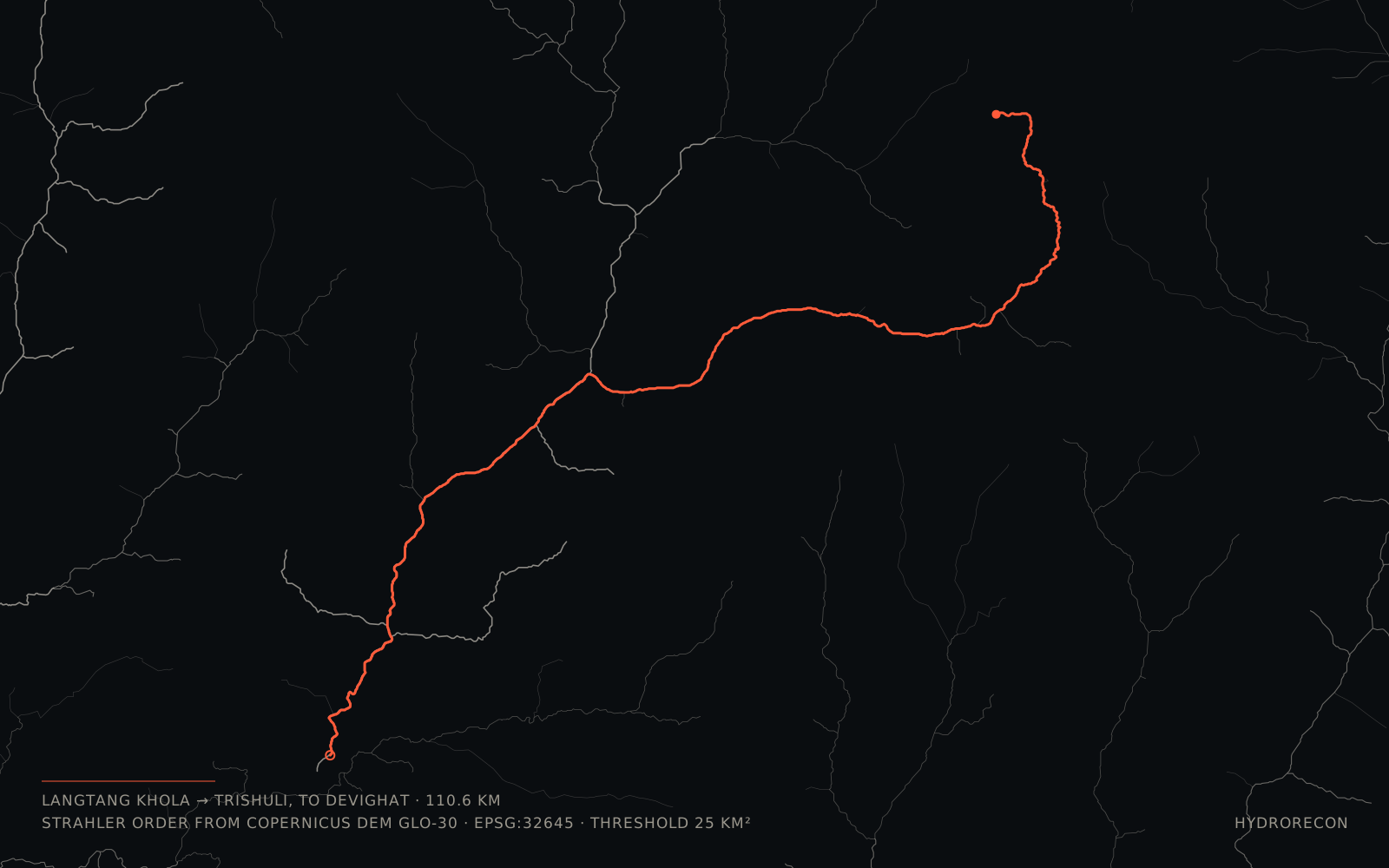
One click walks 22 km downstream and searches about a thousand intake and powerhouse pairs. It keeps the non-dominated set, the pairs that trade energy, waterway length and head against each other.
A turbine is selected for each duty point, with part-load curves applied on every day of record. The calculation prints rho g Q H eta as a visible chain. Output is reported as P50 and P90 annual energy and daily P90/P95 output. It is never labelled firm capacity.
Result
HydroRecon is still in progress. The code is public, and I have checked it against five built Nepali plants, including Chilime and Upper Tamakoshi. It has 287 assert checks.
As an example, a screening run on Chilime Khola gives 442.9 m gross head, 5.37 m³/s design flow, 18.6 MW and 92.8 GWh a year. That is a screening estimate from the model, not a design and not the figures of the built plant. Modelled is not measured.
Built with: TypeScript · React 19 · MapLibre GL · Vite · Electron · GitHub